
Kraken Exchange
Kraken Exchange offers spot and margin trading, known for its deep liquidity and strong security track record.[source]
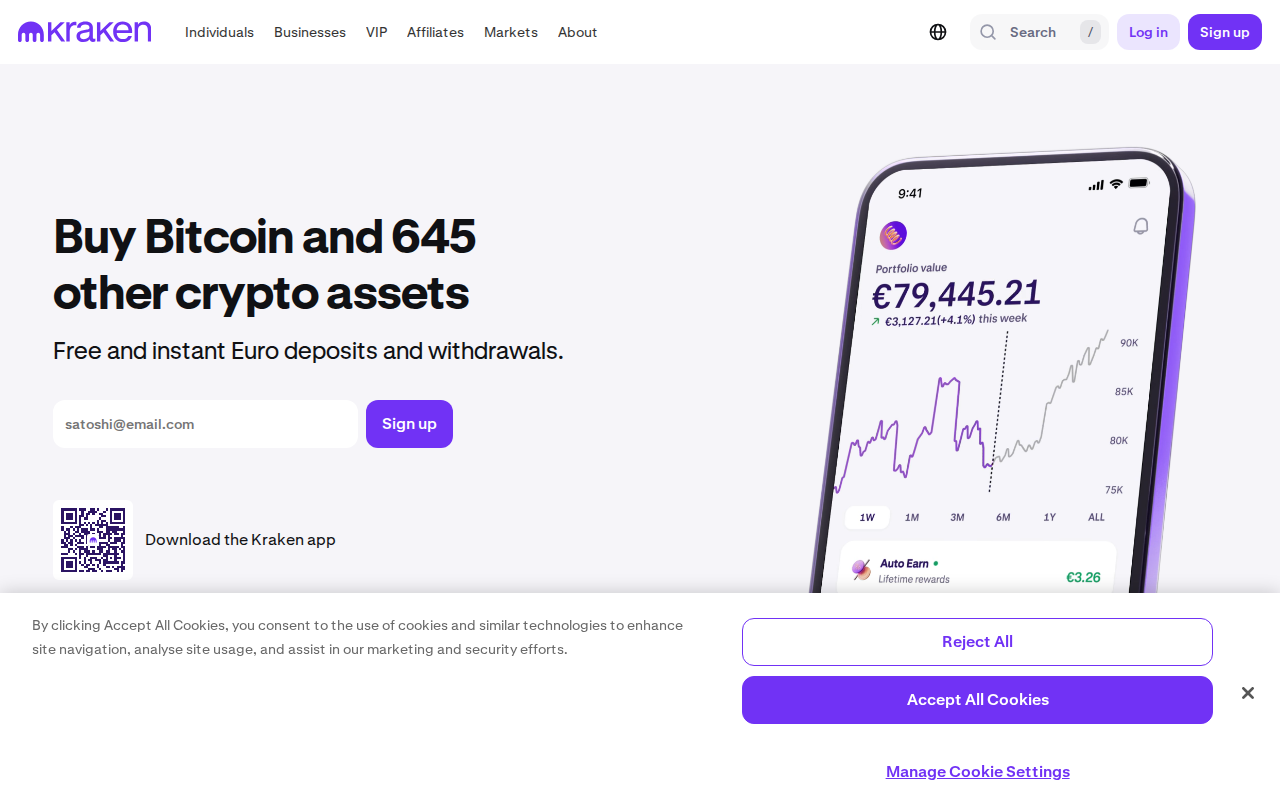
What you should know about Kraken Exchange
- Industry-Leading Security: One of the oldest and most trusted exchanges, with a pristine track record of no major security breaches.
- Low Fees & Deep Liquidity: Advanced traders can use Kraken Pro for significantly lower fees (starting at 0.25%/0.40%) and advanced charting tools.
- Regulatory Transparency: Conducts regular, transparent Proof-of-Reserves audits and maintains strong compliance across major global jurisdictions.
- Broad Asset Selection: Supports over 500 cryptocurrencies with multiple fiat funding options (USD, EUR, GBP) and flexible staking rewards.
Pros & Cons
Strengths
- + Never been hacked
- + Great customer support
- + Low margin fees
- + Proof of Reserves verified (Dec 2025)
- + Regulated stock trading (US)
- + Krak Card available in UK/EEA
Weaknesses
- - Complexity for beginners
- - Withdrawal holds on certain deposit methods
- - Crypto card not yet available globally
Facts about the Kraken Exchange
Kraken Exchange Topics
Why use Kraken Exchange
Unlike many platforms that rely heavily on flashy marketing, Kraken distinguishes itself with an industry-leading commitment to security and transparency. Its rigorous approach to user-verifiable Proof of Reserves offers a level of trust and fund safety that competitors like Binance and Crypto.com often struggle to match, making it the premier choice for security-conscious investors.
Beyond security, Kraken delivers significantly better value for active traders compared to the high baseline costs of standard retail exchanges like Coinbase. Through the Kraken Pro interface, users gain access to a professional-grade trading experience featuring deep liquidity, advanced order types, and highly competitive, volume-based fee tiers. This combination of institutional-grade security and cost-efficiency makes Kraken a superior alternative for serious crypto participants.
Kraken Exchange FAQ
How do Kraken's standard trading fees compare to its Pro interface?
Using the main Kraken interface for instant buys incurs a flat 1.00% fee plus any applicable payment method charges. In contrast, Kraken Pro utilizes a maker/taker model starting at 0.25% for makers and 0.40% for takers, which progressively decreases for high-volume traders.
Does Kraken provide public proof that customer funds are fully backed?
Yes, Kraken regularly undergoes and publishes independent, cryptographic Proof of Reserves audits to publicly verify that customer balances are fully backed by corresponding assets held in their custody.
What leverage limits are available for margin and futures traders?
Eligible clients can access up to 5x leverage for spot margin trading. For more advanced derivatives, Kraken's futures platform supports up to 50x leverage, with highly competitive fees of 0.02% for makers and 0.05% for takers.
Are there commissions on staking rewards earned through Kraken?
While Kraken simplifies the staking process for numerous proof-of-stake networks, it does retain a commission on flexible staking yields. Users should review the specific commission rates applied to their chosen assets before locking them.
How robust is Kraken's security infrastructure considering industry hacks?
Kraken maintains an exceptional track record in the industry, having never been successfully hacked. The exchange pairs this deep security pedigree with consistently highly-rated customer support, though users should be prepared for a rigorous and sometimes slower KYC onboarding process.
Kraken Exchange FAQ
How does Kraken's tier-based fee structure impact high-volume spot and futures traders?
Kraken offers a highly competitive fee structure designed to reward high-volume traders. On Kraken Pro, standard maker fees start at 0.25% and taker fees at 0.40%. However, as your 30-day trading volume increases, these fees decrease significantly. For futures trading, the fees are even lower, with maker fees starting at 0.02% and taker fees at 0.05%, making it highly efficient for institutional and active retail traders.
What are the leverage limits and margin requirements for Kraken's futures and margin trading platforms?
Kraken provides robust options for advanced traders seeking leverage. Eligible clients can access up to 5x leverage for spot margin trading. For those looking for higher exposure, Kraken's futures contracts offer up to 50x leverage. It is important to note that accessing these features requires meeting specific eligibility criteria and understanding the associated liquidation risks.
How does Kraken verify the security of customer funds through its Proof of Reserves audits?
Kraken is an industry pioneer in transparency, regularly publishing cryptographic Proof of Reserves audits. These audits allow individual clients to cryptographically verify that their account balances are fully backed by the exchange's on-chain assets. This regular independent verification provides a high level of assurance regarding the solvency and security of funds held on the platform.
What are the cost differences between Kraken's Instant Buy feature and their Advanced Pro trading interface?
There is a significant cost difference depending on the interface used. The Instant Buy feature on the main Kraken app is designed for convenience and charges a 1.00% fee, plus any additional fees associated with the payment method. In contrast, using the Kraken Pro interface utilizes the order book, where fees are much lower, providing a much more cost-effective solution for those willing to navigate a professional trading interface.
How does Kraken handle staking rewards for Proof-of-Stake networks and what are the associated commissions?
Kraken simplifies the staking process by allowing users to earn rewards on various Proof-of-Stake networks directly from their exchange wallets. While this offers immense convenience and immediate liquidity for supported assets, Kraken does take a commission on the generated rewards to cover the operational costs of running the validator nodes. The exact commission varies depending on the specific network being staked.